

Connect humanitarian systems

Share data between different beneficiary management systems and other databases without replacing them.

Exchange data safely

Map different local data structures into a shared HumX contract so each organisation can keep its own internal model.

Keep organisations in control

Every transaction is routed, logged, validated, retried when needed, and protected by organisation-level permissions.

Secure exchange layer between humanitarian systems

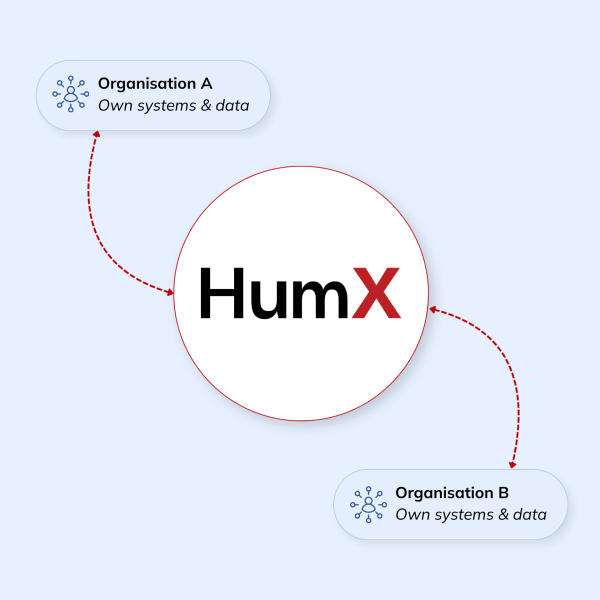
Humanitarian organisations often rely on different case management systems, spreadsheets, mobile data tools, custom applications, and partner databases. These systems may all hold useful information, but they rarely speak the same language. HumX creates a shared exchange layer between them. Instead of forcing every organisation to adopt the same software, HumX lets each partner keep its own tools while agreeing on common service contracts, routing rules, and security requirements.

HumX

What can HumX do?

Service exchange

Define shared services and operations, such as creating and following up on referrals, deduplication of assistance, live data aggregation, and service mapping.

Smart routing

Route requests to the correct organisation and system using permissions, service participation, fixed routing, or values resolved from the incoming data.

Push or listen

Support systems that can actively send data as well as passive systems that need to be listened to for new records. Listening can detect new items, create HumX transactions, and acknowledge processed records back to the source.

Service catalogue

Discover which organisations provide which services and where. Catalogue probes can be cached and filtered, for example by service and location.

Reliable asynchronous delivery

Queue transactions, retry temporary failures with backoff, and move exhausted requests into a dead-letter state instead of losing them.

Diagnostics and monitoring

Inspect transaction attempts, mapped requests, remote responses, validation errors, exact outbound URLs, retry decisions, and operational statistics.

Secure payload handling

Protect sensitive request and response payloads with authenticated encryption at rest, retention rules, secret redaction, and controlled diagnostic access.

Connect systems without forcing organisations into one platform

HumX does not require every organisation to use the same software. It standardises the exchange between systems while leaving each partner free to choose its internal tools. That makes interoperability more realistic in humanitarian networks, where technical capacity, infrastructure, workflows, and data models can vary significantly between organisations. HumX turns many separate point-to-point integrations into one governed interoperability layer.
HumX

Start with one workflow. Grow into a network.

HumX can be introduced gradually. A first integration can connect two organisations for a single referral or service-discovery workflow. The same service contracts, security model, mappings, monitoring, and transaction infrastructure can then be reused as more partners and services join.